The concept of the “Open API”1 has held various levels of esteem and support over the previous decade. It emerged as a fundamental building block of the Web 2.0 movement, with services like Flickr and Google Maps launching officially supported APIs a short while after launching themselves. The social giants Twitter and Facebook followed with APIs of their own. By the end of 2006, it seemed like an open API was a prerequisite for a successful launch.
But support for these APIs started to wane as the early Web 2.0 companies started to mature and focus on growing revenues and owning their platforms. For Twitter in particular, the appeal of following Facebook’s lead and creating a ‘walled garden’ was too great. They (in)famously began to restrict access to their API in 2012. Some critics of the company see this change as the root cause of some of the major issues facing Twitter today, such as the stagnation of user growth and a lack of meaningful platform innovation.2
Twitter was far from the only major company to make such a change however—by the end of 2015 Netflix, Facebook, Instagram, LinkedIn, and others had shut off open access to their APIs. These API shutdowns didn’t just have a negative impact on developers. As the drawbridges went up, users started to feel the negative effects. People began to lament the end of the open web.
Recently however, open APIs have been having something of a renaissance. This has been driven in part by the explosion of messaging—Facebook Messenger, Slack, HipChat, Telegram, LINE, WeChat, and others all offer open, well documented APIs that allow developers to build integrations for their platforms. The hope of these companies, and one that has been largely rewarded, is that developers will build applications on top of their messaging platforms, increasing the overall value. Slack has even started a $80-million dollar venture capital fund for companies who are building integrations for their platform.
For these new messaging platforms, it’s an important part of their value proposition—both to their investors and their users. But it isn’t just a one way street. We’re seeing more and more companies with open APIs that allow developers to tie together various platforms and services in a way reminiscent of the early days of Web 2.0 and the ‘remix culture’ that produced sites like HousingMaps and WeatherBonk.
Companies like Uber don’t care how you call an Uber, just that you do—and their API makes sure that it’s as easy as possible for developers to enable just that. Payment startups Square and Stripe don’t care where the payment is taking place or what’s being paid for, just that they process it. For smaller startups, it can be a great way to expand reach without the overhead of a business development team. There are even startups popping up that do the hard work of connecting various products and services for you.
Messaging’s emergence as the central interface paradigm on mobile and the resulting explosion of messaging platforms has companies building open APIs again, and that’s a good thing. For developers, being able to tap in to a rich ecosystem of existing building blocks allows for rapid prototyping, iteration, and increased focus on what makes their product or service unique. In turn, app-weary customers are rewarded with applications that are integrated where appropriate to provide the best experience, instead of having services walled off from each other. The open web is dead—long live the open web!
Happy New Year! After looking back at the end of 2015, now it’s time to look forwards to the year that will be. Here are the albums and the games I’m looking forward to in 20161.
Music
- Animal Collective - Painting With
Single: FloriDada music spotify
- Beck - TBD
Single: Dreams music spotify
- Bloc Party - Hymns
Single: music spotify
- Drake - Views From the 6
- Frank Ocean - Boys Don't Cry
- Gorillaz - TBD
- James Blake – Radio Silence
- Japandroids - TBD
- Kanye West - Swish
Single(?): FACTS Soundcloud
- M83 - TBD
- Radiohead - TBD
- The xx - TBD
- Vampire Weekend - TBD
Games
I love year end lists - for the list reader they’re an excellent way to take in annualized curation (the internet is a big place and it’s easy to miss great stuff!). For the list maker they’re a great way to look back on the year that was and take stock of it. Here are my year end lists for 20151.
Music
Apps (iOS)
Apps (Mac)
Games
Earlier this year, I took a look at the options for hosting a blog in 2015. I ended up settling on Tumblr, tweeting:
Tumblr was always a weird place to host a blog in the traditional sense of the word. I had settled on it because I found their custom theme implementation far simpler than anything else out there. And it’s hard to beat free! But Tumblr is more a social network than a blogging platform - they introduced messaging in November. It began to feel like I was having to fight harder and harder against the interface - avoiding reblogs, likes, usernames. So when I visited my site on my iPhone a few days ago and was greeted with a floating banner promoting the tumblr app, I knew it was time for a change.
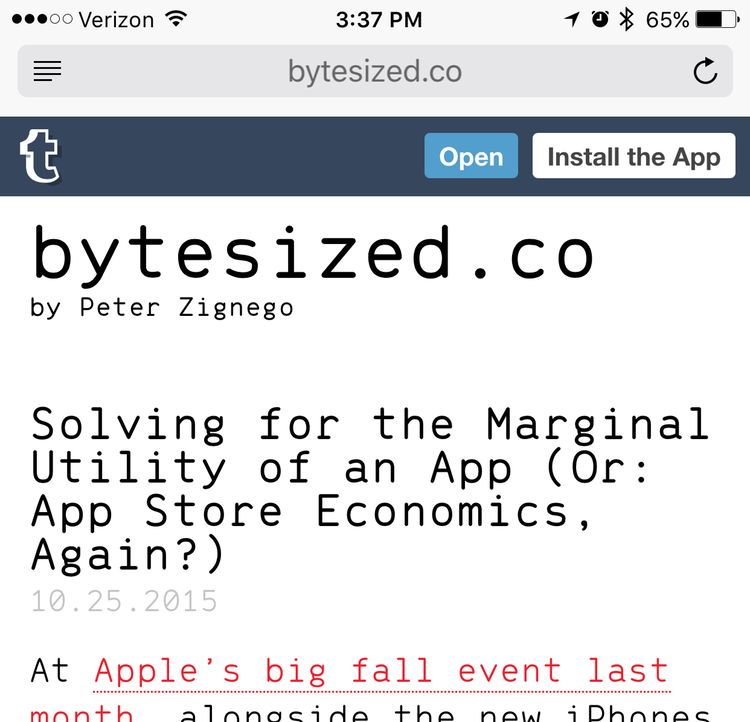
I had been tangentially aware of Realmac Software’s new crowd-funded blogging platform, Typed.com. So when Dan Counsell tweeted about rolling out beta access to theme support, I took the plunge.
A few hours later, I had my transferred my layout, added my old posts, and switched over my domain.
Things I Liked:
- Full customization - there’s no required boilerplate.
- The sample theme provides a good jumping off point.
- Simplicity. If you know basic CSS and HTML, you should have no problem customizing your blog to your liking with the help of the documentation.
- The Theme Preview.app makes it easy to perfect your theme locally.
- Markdown and raw HTML support.
- The ability to backdate posts. This allowed me to bring over my existing posts with their existing post dates.
- Post tagging support.
Things I Disliked:
- No ability to preview a post before publishing it.
- No post import. You have to bring your posts over one by one using the editor.
- You have to enter a credit card number to sign up for the 'free trial'. On the Typed.com home page, they explain it like this:
To ensure your Typed website remains accessible to readers at the end of your trial, we require a credit card to start one.
This is cheesy explanation for what is a customer hostile business decision, plain and simple. When you require a credit card to sign up for your free trial, you’ve already got me questioning your intentions - don’t exacerbate it by trying to bullshit me on why.
Would I recommend Typed? That’s a hard question to answer. A recurring subscription is a hard sell for something with a lot of free alternatives out there. If you’re willing to deal with a few annoyances, you could use Tumblr for free like I was. If you don't need or want to control the design of your blog, you'd be hard pressed to do better than Medium - I’ve been cross posting my blog posts there and find the experience to be excellent. But if you're serious about having a good old-fashioned blog, Typed provides a great experience for a reasonable price.
At Apple’s big fall event last month, alongside the new iPhones and a larger iPad, they unveiled an entirely new platform - tvOS. The announcement has stirred up fresh discussions of an evergreen topic for Apple’s third-party developers - the sustainability of building software for Apple’s platforms. I’ll be focusing on the ‘what’ and the ‘how’ here - the ‘why’ has been covered extensively.
Apple’s user base has grown so large, and both the company and it’s products have so much momentum, that it seems unwise to bet against their success. As with the Apple Watch, there will be thousands of applications available on launch day for tvOS regardless of how many words are spilled over App Store sustainability. But will Apple’s new platform for the living room support a strong independent software market like the one that has sprung up around the Mac, or will it more closely resemble the race-to-the-bottom freemium graveyard that is the iOS App Store?
Brent Simmons summarizes one position nicely: could it be simple ‘bigger is better’ psychology at work - that the bigger the screen, the more money you can charge? No - software’s value has never and will never be determined by it’s 'physical' size. Software’s value comes from the marginal utility that people get from it.
Using this framing, it’s clear that the market for tvOS apps will closely mirror what we see dominate the iOS app store - free applications with in-app purchases. The vast majority of the applications we use on our phones are for entertainment, not productivity.1 As Ben Thompson eloquently put it in a recent article about Facebook:
It is only when we’re doing something specific that we aren’t using our phones, and the empty spaces of our lives are far greater than anyone imagined.
Most apps are simply entertainment,2 filling in those empty spaces in our lives. And while people enjoy being entertained, the marginal utility of being entertained by one app instead of another, or by something else entirely, is minuscule. This devaluing of entertainment happens everywhere, even though it’s easiest to recognize when the hornet’s nest that is the internet gets stirred up. It’s a time honored tradition to complain about how much movie ticket prices have gone up while you’re waiting in line to see a movie. The amount of time it takes to complete a video game has become a major component of modern game reviews because people care so deeply about that dollars per hour calculation. All these things are manifestations of the strange mental calculus we perform that informs what intangible entertainment "experiences" are worth.
When your product is entertainment, you’re competing for attention - and everything is competition. Even highly differentiated experiences don't produce an overwhelming increase in marginal utility for most people. I believe 99% of tvOS applications will fit the mold of apps as entertainment, and that the overall market for apps on the TV will be relatively small.3 In opposition to the phone, where you can seek out and discover new apps in those empty spaces, sitting down and turning on your TV set and Apple TV requires intent, a far greater hurdle. This is in direct conflict with how most people consume TV today - it is the ultimate passive consumption medium.
The top applications will be well known content destinations - the traditional networks (ABC, CBS, NBC, etc.), along with Netflix, Hulu, and their ilk. The biggest potential winners on the platform will be the Youtubes and Twitches of the world - the new media companies that will be able to create new, dynamic consumption experiences that leverage the large screen and unique potential for having paired iOS devices as a second screen - the most advanced remote control in the world.
All this isn’t to say I think that the Apple TV will be a failure - far from it. With Apple’s momentum and the support from third-party developers,4 I think that the Apple TV will be a tremendously successful platform for consuming content. That just isn’t the basis for a sustainable software platform.